





History
‘An old house may be built of the humblest, simplest materials, and, like a bird’s nest, be a thing of great beauty.’ Roger Deakin, Notes from Walnut Tree Farm
The village of Mellis, in which Walnut Tree Farm sits, is an ancient one, recorded in Domesday variously as “Melles”, “Metles” and “Mellels”. The village borders an expansive 150-acre grazing common where the houses are set far back from the road down individual lanes, almost invisible from the road when the trees and hedges come into leaf.
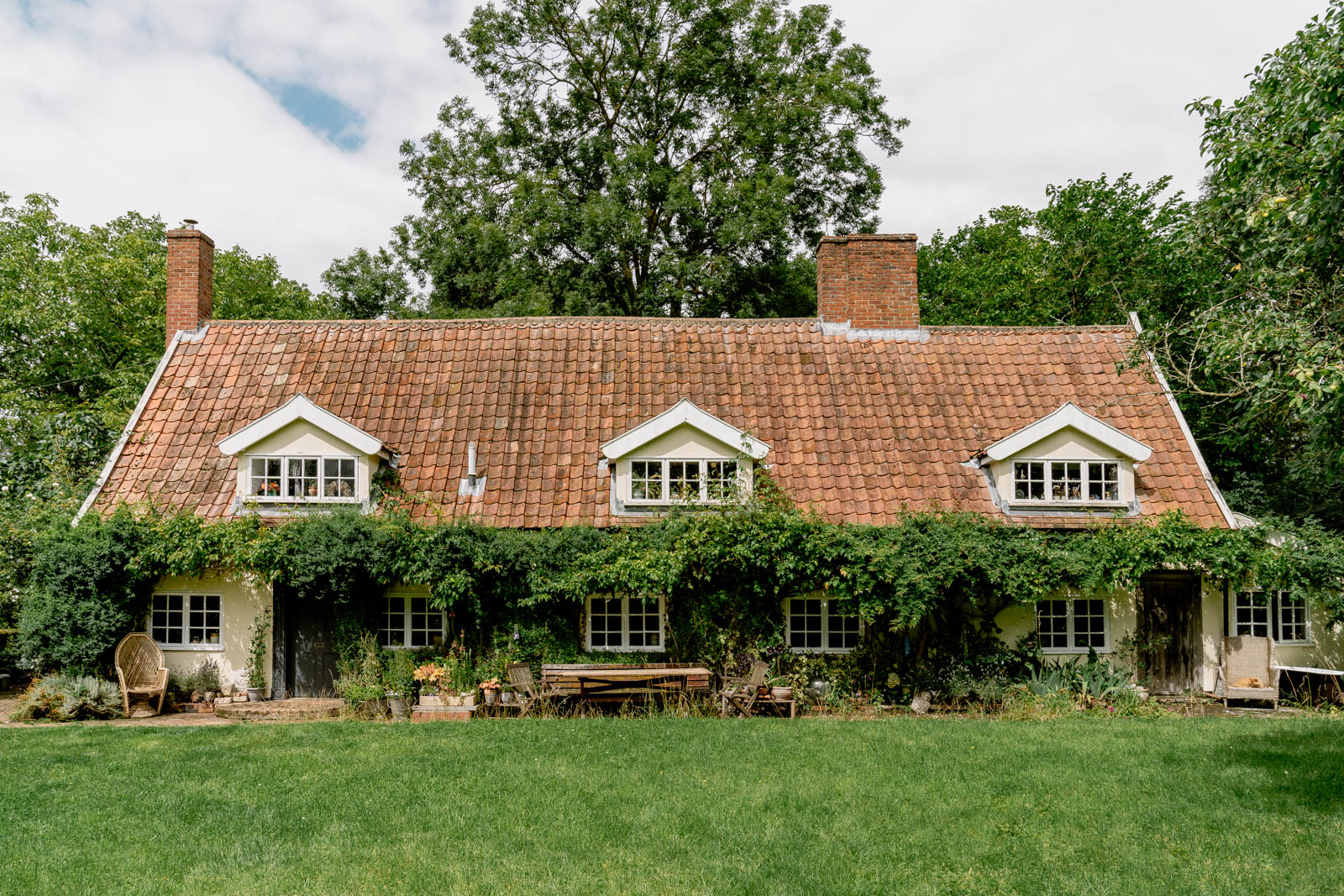
The core of the Grade II-listed farmhouse dates from the 16th century; it was likely originally a two-bay open hall. Throughout the years, various extensions and alterations have been carried out, eventually dividing the house into three small labourers’ dwellings.
For centuries the area was predominantly agricultural, eventually declining after the Second World War as farm work became increasingly mechanised. Agricultural buildings and dwellings were then left to degrade or, as for Walnut Tree Farm, used to keep livestock such as pigs and chickens.
Roger Deakin bought the farm in 1970, at which point it hadn’t been inhabited for almost 20 years and was in a severe state of disrepair. He stripped the building to its skeleton of oak, ash and chestnut timbers – 323 in all, estimating that 300 trees would have been felled to build it. A careful, detailed restoration followed; repairing the structure where necessary, replacing the thatch and tin roof with East Anglian pantiles, and finally battening, boarding, lathing, and rendering the exterior walls.
Once the exterior shell was weatherproof, Deakin gradually developed the interior spaces room-by-room in a manner faithful to the house’s origins, salvaging and repairing in kind where possible. This deeply personal project ensured his character is evident throughout. At the heart of the house, the kitchen still holds a brick in the floor inscribed with the following poem by his friend, Tony Weston:
‘This house was built by my true friend, His work stands up, his labours end.
By this place he will be known
To those who never know his face’
The following decade was spent establishing a system of sustainable agriculture on the farm; in the fields, he began a programme of managed grazing and haymaking and quickly amassed a variety of livestock. However, as Deakin’s work commitments increased farm work was scaled back and writing took priority. The land offered the opportunity to install a number of outbuildings and small structures for writing, sleeping, and reading, including a shepherd’s hut and a 17th-century barn from a neighbouring farm that he dismantled, transported and reconstructed by hand.
It wasn’t until the 1990s that Deakin took the opportunity to properly dredge the moat and began his daily swims. Centuries of silt were removed from the moat, creating a 10ft deep pool rich with wildlife and the place of inspiration for his first book, Waterlog.
Following Deakin’s premature death in 2006, his will requested that the house be mothballed for 12 months. By the late 2000s, the house had almost reached the ruinous state that Roger found it in, however soon family friends Titus and Jasmin Rowlandson took over the farm and sensitively repaired some of the structures including the shepherd’s hut, whilst allowing some vehicles and structures to return to nature, hedged by brambles and wild hops.
The farm remains intrinsically linked to Roger and his writings and has served as an inspiration to many around the world; offering a dream of reconnection with the land, of creativity and self-sufficiency. However, it is now time for the next chapter. This idiosyncratic relationship with the house is best described by Roger’s close friend and fellow nature writer Robert Macfarlane;
‘The Rowlandsons, too, have grown into their own closeness with this spellbinding place, and the story of Walnut Tree Farm is theirs too – as it will, in time, become someone else’s, and then someone else’s again.’
 Related Stories